
Contactless Entry: Why Singapore Offices are Switching from Fingerprint to Face Recognition
For years, the fingerprint scanner was the gold standard for office security in Singapore. From the industrial hubs of Tuas to the skyscrapers of the CBD, “tapping in” was part of the daily routine. However, 2026 marks a definitive shift.
At Assista, we are seeing a massive migration toward Contactless Face Recognition. But is it just a trend, or is there a technical and operational “Thinking-First” reason for the switch? Let’s analyze the transition.
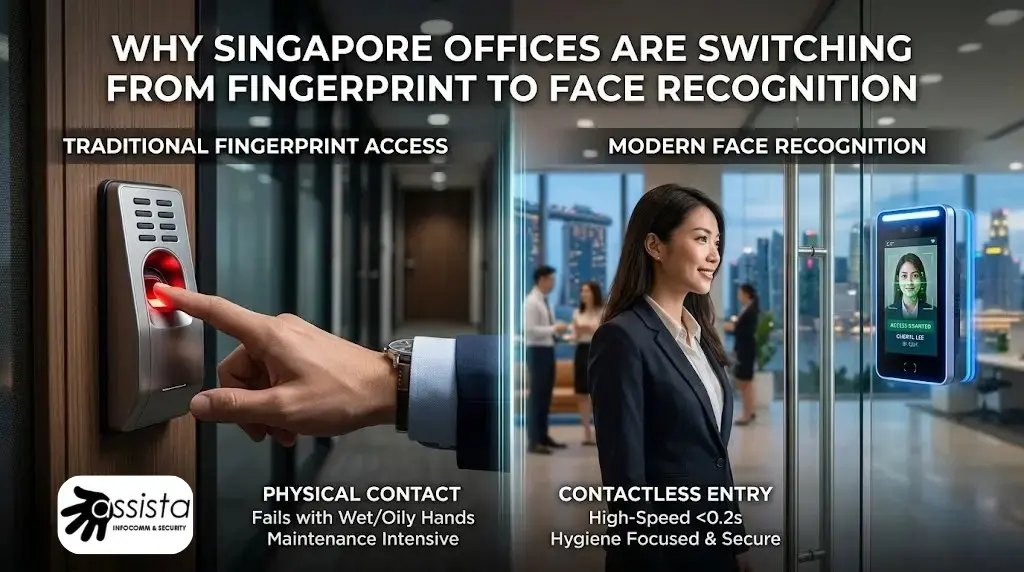
1. The “Humidity Factor”: Why Fingerprints Fail in Singapore
Singapore’s tropical climate is the natural enemy of biometric fingerprint sensors.
- The Issue: High humidity leads to sweaty or oily fingertips, which can blur the ridges of a fingerprint. This results in “False Rejections,” forcing employees to scan multiple times—creating a bottleneck at the entrance during 9:00 AM rushes.
- The Face Solution: Facial recognition is an optical and algorithmic process that doesn’t care about skin moisture. Whether an employee has just stepped out of the rain or is carrying coffee, the terminal identifies them at a distance, ensuring a “zero-friction” entry.
2. Hygiene and the “Contactless” Standard
Post-pandemic, the psychology of the workplace has changed. Many employees are now hesitant to touch a communal sensor that hundreds of others have touched.
- The Technical Shift: By removing physical contact, you remove a vector for germ transmission.
- Operational Benefit: Contactless systems require less cleaning and maintenance. Fingerprint prisms often get scratched or clouded by oils over time; facial recognition lenses remain clear and functional for much longer.
3. Security: Anti-Spoofing and “Living Body” Detection
A common concern with face recognition is the “Photo Spoof”—can someone hold up a picture of an employee to trick the camera?
- The Physics of Security: Modern Hikvision and ZKTeco terminals use Dual-Lens technology. One lens captures the visual image, while the other captures Infrared (IR) depth.
- The Result: The system can distinguish between a flat 2D image and a 3D “Living Body.” It looks for the heat signature and the depth of the nose and eye sockets. This makes it significantly harder to bypass than older, budget fingerprint systems.
Face vs. Fingerprint: The Comparison Matrix
4. Integration with Singapore HR & Payroll
One of the biggest reasons for the switch is the Data Integrity. In many Singaporean warehouses and construction sites, “Buddy Punching” (where one employee scans for another) was a problem with proximity cards. Fingerprints solved this, but facial recognition perfected it.
- Automated Logs: The system captures a log of exactly who entered and at what time.
- Easy Export: These logs can be synced with most Singapore payroll software, making it easier for HR managers to calculate OT (Overtime) and lateness without manual tallying.
5. PDPA and Privacy: The “Hashing” Myth
A frequent hurdle for Singapore SMEs is the fear of PDPA (Personal Data Protection Act) violations.
- Expert Insight: You are NOT storing photos of your employees’ faces on the device. Instead, the terminal creates a Mathematical Hash (a string of numbers) that represents the face. Even if someone stole the device, they couldn’t “reconstruct” a photo from that data.
- At Assista, we guide our clients on how to draft their internal privacy policies to ensure full compliance while enjoying the benefits of biometric tech.
Conclusion: Is it time for your office to pivot?
If your current fingerprint system is lagging, or if you’re tired of replacing “lost” access cards, the move to facial recognition is the most logical upgrade for 2026. It’s faster, cleaner, and ultimately more secure for the modern Singaporean workplace.
When your management team is ready to shift away from traditional fingerprint touchprisms, follow our engineering roadmap on how to deploy a modern face recognition door access system inside a commercial Singapore property safely.
Interested in seeing how this would look at your office? View our Face Recognition Installation Packages or contact us for a discussion.
